Beginner's Guide: Surviving Your First 30 Waves in Wireworks
Quick answer: a standard Wireworks run ends at wave 30 — get there and you clear the run and unlock the next difficulty tier. Every death before that comes down to three things beginners get wrong: overspending in the first shop (it's capped at $10 anyway), upgrading items one at a time instead of stacking base copies first, and not resetting a dead-end opening. Fix those three and wave 20 stops being a wall.
"Just bought Wireworks and I keep dying around wave 20…"
If you're consistently dying around wave 20, the run was probably already decided by wave 3–5 — a weak opening shop that never recovered, not a sudden difficulty spike. Wireworks is a wiring puzzle: your board (items placed in slots and connected by red wires) has to scale its damage roughly in step with enemy scaling, and a build that stalls out on the wrong items falls further behind every wave. The community's blunt fix is quick-restarting rather than grinding out a doomed run: hold R or ` (backtick) to instantly restart, and reset until the first shop gives you a viable opener. On Difficulty 2 and above, a bad opening shop is genuinely often unwinnable — resetting is the strategy, not a failure. Experienced Difficulty 5 players openly reset dozens of times until a key item (a good wand, or the Golf Club for a Tinker run) appears.
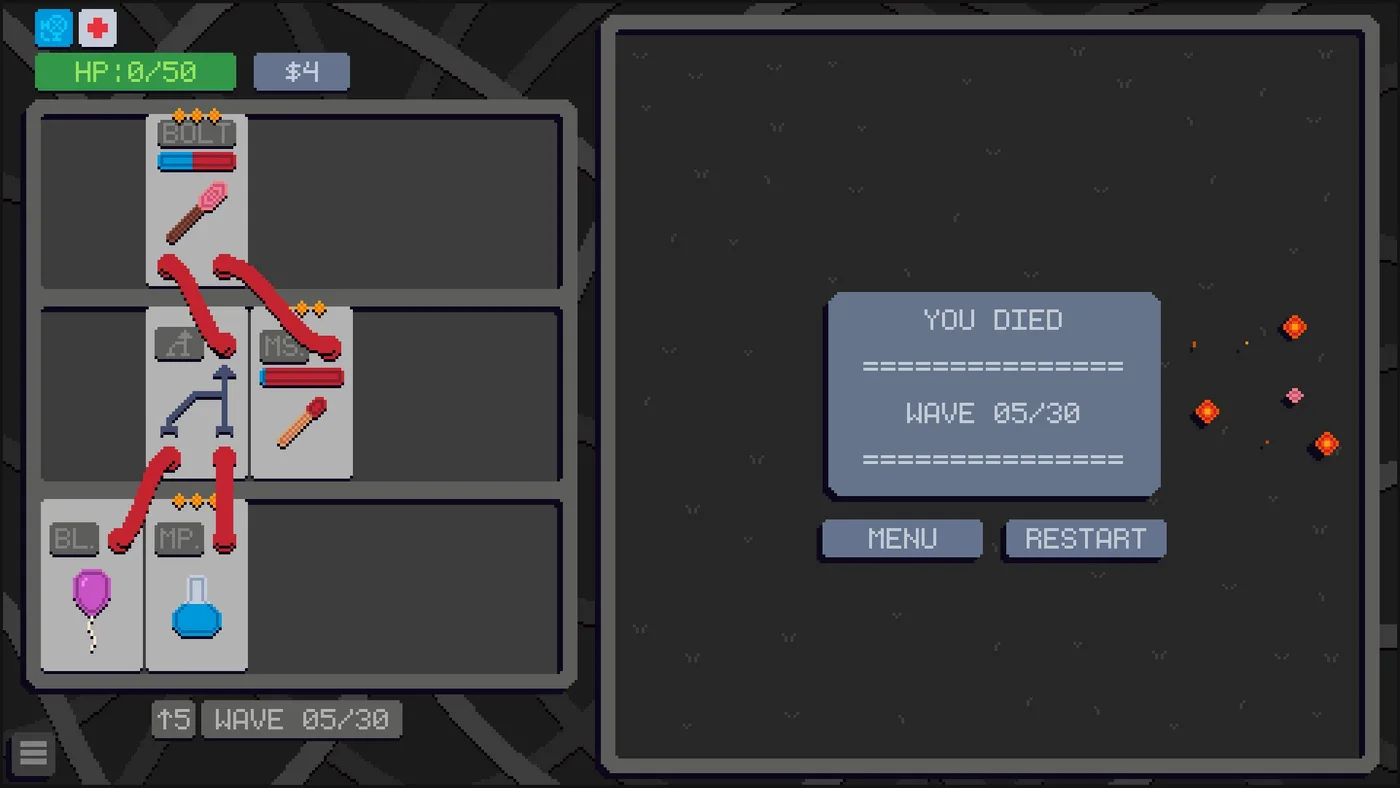
This is exactly the kind of board that dies around wave 5–20: two half-built weapon lines and no economy engine yet. The same player later cleared Difficulty 5 with a fully-built version of this same opener (see below) — the difference wasn't luck at wave 20, it was the shop rolls at wave 3.
What should I buy first?
Buy whatever the first shop's cheap pool actually offers you — you can't plan around specific items because the first shop never sells anything over $10 (dev-confirmed on the JJJ Games Discord). That single rule defines every opening in the game: there is no "always buy X first" answer, only "build around whatever's cheap this run." A few character-specific starting lines that consistently work:
| Character | Opening line |
|---|---|
| Goblin | Starts with $20 (since Balance 1.2) — rush toward 2 upgraded Recyclers for free rerolls, which snowballs into whatever economy or damage engine the shop gives you next. |
| Mage | Phial + Bolt + Waves. Wands are the forgiving early archetype because they deal damage twice — once on projectile impact, once when their effect connects — so every cast double-dips. |
| Tinker | Reset until you see Golf Club — it's the Tool that reliably carries a Tinker run past round 3. Paintbrush is the acknowledged backup if Golf Club never shows. |
Outside of character openers, Staff is a strong early generic buy purely because of its board size — it covers more of the board and buys you time while your real engine comes online.
What should I look for in the first shop?
Look for cheap items that can either scale (a wand, a Mech-chip piece, an economy module) or stack — since every item in the first shop costs $10 or less, you're never choosing between "good" and "great," only between "buildable" and "dead end." Two things beginners miss:
- Recyclers reduce your reroll cost even sitting unwired in the bank — three upgraded copies drop rerolls to $0, which is the single biggest quality-of-life engine in the early game.
- Pre-wave 10, board-topology items (Merger, Splitter, Recycler, 3-Merge, 3-Split) and pre-wave-20 items (Mixer) simply cannot appear — don't waste rerolls hunting for them before those waves.
If the shop offers nothing you can build around, that's your signal to quick-restart rather than force a weak line.
How do item upgrades work?
Upgrading means combining two copies of the same base item into one upgraded copy with a stronger effect (e.g. Switchblade's upgrade adds "+1 Stab per Mech"; Golf Club's adds "+1 Ball on Use") — and the community's core rule is stack your base copies before you upgrade any of them. Here's why that order matters, straight from the shop's own logic:
- Before Endless, you can hold at most 1 upgraded copy (or 2 base copies) of any given item. The moment you own an upgraded copy, the shop stops offering that item at all.
- So if you upgrade your first two copies immediately, you lose the ability to buy a third or fourth base copy to build toward a bigger stack — the shop pool for that item is gone.
- Workaround (the stack-then-upgrade rule): buy base copies as they appear, hold them un-upgraded, and only combine them once you've collected as many as you plan to run. Then upgrade them together.
- Sell-back is free: upgraded items sell back for 100% of their purchase price, so if a stack doesn't work out, you lose nothing by rebuilding.
This 1-upgraded/2-base cap is deliberate — it's what keeps Endless-tier infinite-scaling builds locked out of the standard 30-wave run. In Endless (after wave 30) the shop offers upgraded duplicates freely, which is exactly what unlocks the exploit-tier builds late players chase.
Walk me through how a full run works
A full Wireworks run has four repeating phases — shop, wire, fight, repeat — for 30 waves, then a fork:
- Shop. Between waves you spend cash on items ($10-cap on wave 1, wave-gated items unlocking as you go — board-topology pieces at wave 10+, Mixer at wave 20+). Roughly half the shop's stock each visit is "common" (≤$10) and half is "rare" (>$10).
- Wire. Place bought items into board slots and connect them: an item's output feeds another item's input, forming a network. Remember "adjacent" is horizontal-only — vertical effects always say "above" or "below" explicitly.
- Fight. The wave plays out automatically based on your wiring — DMG, SPD, AMP and Size stats on your items determine how hard and how fast you hit.
- Repeat, with an economy layer running underneath. Recyclers cut reroll cost, Piggy Bank/Processor/3-merge combos generate cash between rounds (community builds report ~$378–$400/board), and every upgrade decision from the section above compounds across the whole run.
- Reset when needed. Save-and-reload mid-run is safe, and permanent progress (kill-stack damage, crafted items, tool-use growth) survives a wave reset — but a genuinely dead opening is best abandoned with a quick-restart rather than played out.
You beat — or "clear" — the run by surviving to and completing wave 30. On the hardest tier, Difficulty 5 (also called Level 5 informally, internally maxDiff), this is the tightest part of the whole game: no duplicate-stacking engines are available yet, so every shop roll matters and resetting for a viable opener is standard practice, not a crutch.
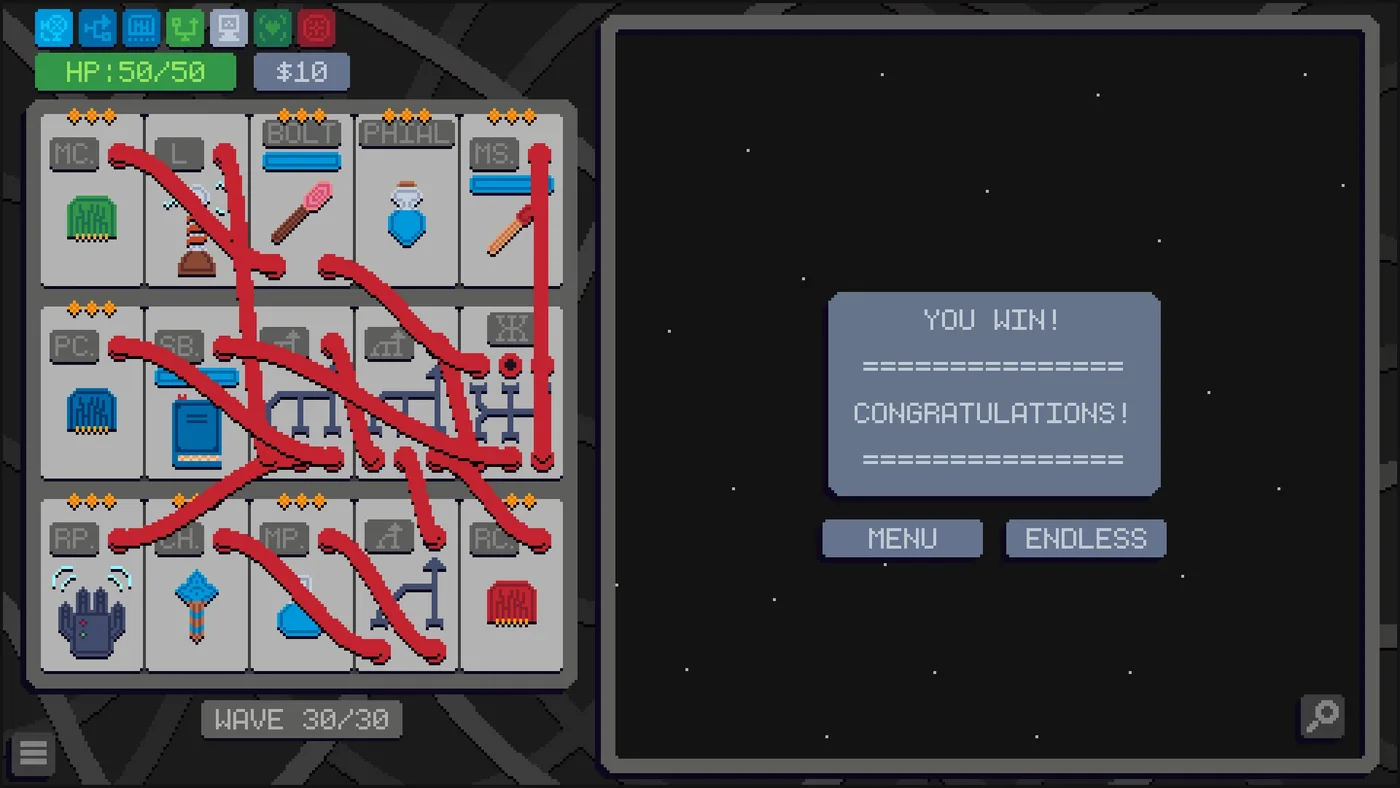
This is the same "Bolt solo" line documented from a Difficulty 5 clear: by round 3 the checklist was Matchstick + Phial + upgrades to Bolt or Mana Potion — reset if the shop won't give it — and from there the run is a straightforward economy-and-upgrade grind to wave 30.
How many waves are there?
A standard run is 30 waves — that's the full base-game clear, whether you're playing Difficulty 1 or Difficulty 5. (The free demo only required beating the first 10 waves, which is why demo unlock progress doesn't carry over 1:1 into the full game.) Past wave 30, the game doesn't end — it opens into Endless mode, which runs in loops of roughly 100 waves each and scales enemy HP/damage/speed indefinitely. Players who push deep into Endless report reaching waves in the 400–1000+ range, usually over many hours (some leave the game running overnight in Auto mode, added in Gameplay Update 1.1).
What happens after wave 30?
Clearing wave 30 does two things at once: it unlocks the next difficulty tier for that character, and it opens Endless mode as a continuation of the same run. Both are dev-confirmed mechanics, not community guesswork:
- Difficulty unlock: beating wave 30 on a given difficulty unlocks the next of the game's 5 tiers. Unlock state is stored per-save in
Wireworks/Wireworks_Data/UserData/{SteamID}/save.jsonunder themaxDiffUnlockvariable — editing it is unsupported, but it's the exact mechanism the dev has pointed to when explaining how demo veterans skipped ahead. - Endless unlocks the item caps. The 1-upgraded/2-base ownership limit that shapes your first 30 waves disappears — the shop offers upgraded duplicates freely, which is what makes stacking-and-scaling builds (Chest+Raccoon, Biochamber "baking," Dog Whistle pet networks) possible. It's also where the real difficulty shifts from "enemy damage" to "your own framerate" — past roughly wave 100–150, FPS becomes the bottleneck, not enemy HP.
- Clearing wave 30 on any character with any difficulty is also the unlock condition for the Tinker character (beat the game once, with anyone).
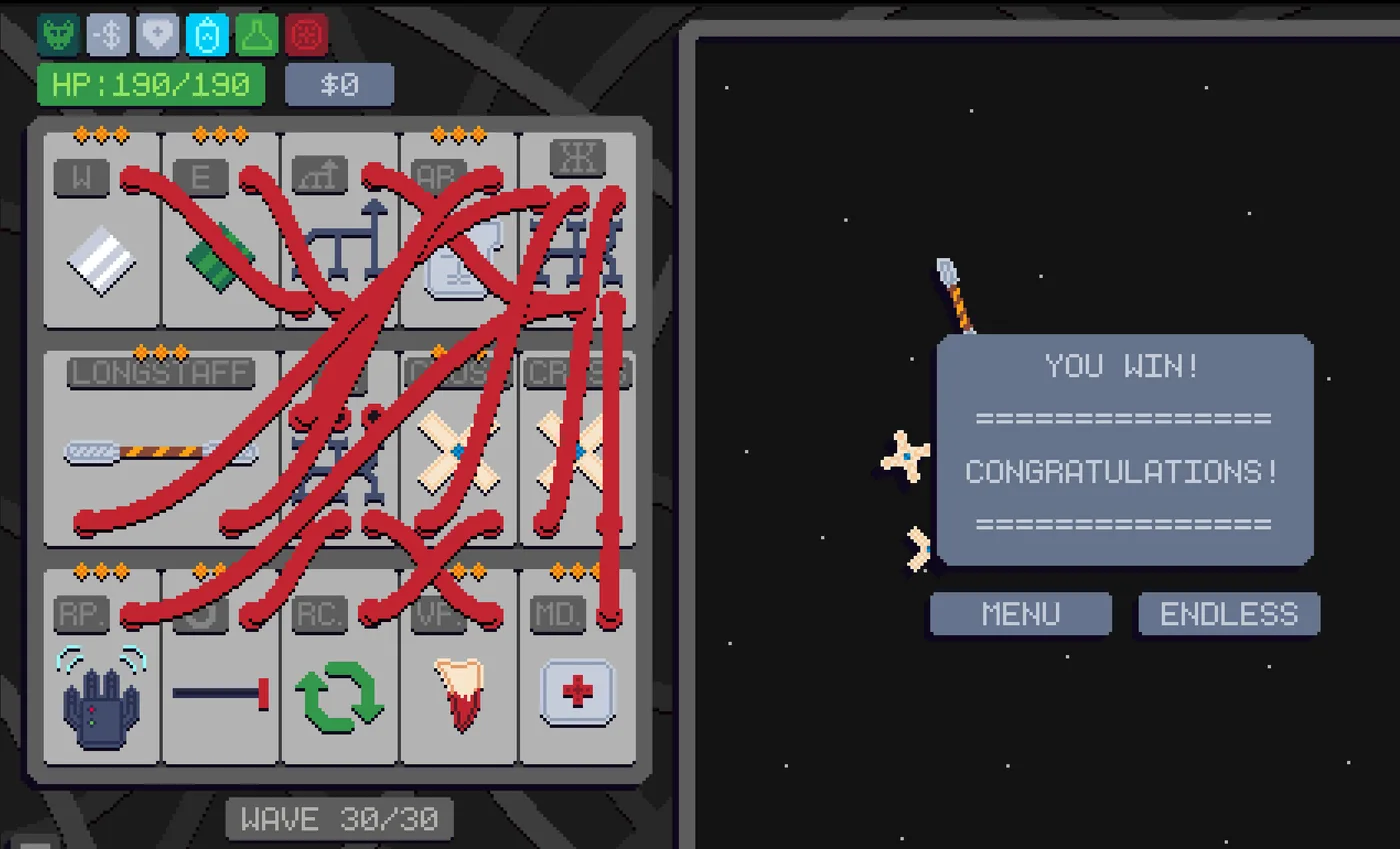
As of August 2026, Wireworks is $6.99 on Steam and sits at 90% positive across 570 reviews ("Very Positive") — worth knowing if you're deciding whether to push through a rough first 30 waves before judging the game.
Quick adjacency reference — "adjacent" in item tooltips means horizontal neighbors only; vertical relationships only count when a tooltip explicitly says "above" or "below" (dev-confirmed):
        [ above ]        ← only counts if the tooltip SAYS "above"
[adjacent] [ITEM] [adjacent]   ← "adjacent" = these two slots only
        [ below ]        ← only counts if the tooltip SAYS "below"
Unofficial, community-compiled. Balance numbers drift between patches — trust in-game tooltips. Sources: developer answers on the JJJ Games Discord, Steam patch notes.