Wireworks vs Rogue Voltage — Which Module Game Should You Buy?
Short answer: buy Wireworks if you want a fast, twitchy roguelike tower-defense with wiring puzzles and an active endless-scaling metagame; buy Rogue Voltage if you want a calmer, more turn-based RPG-battle experience built around the same "modules manage a resource" idea — and notably, Wireworks' own solo developer has publicly recommended Rogue Voltage to players who like his game, so this isn't really a rivalry.
compare wireworks and rogue voltage
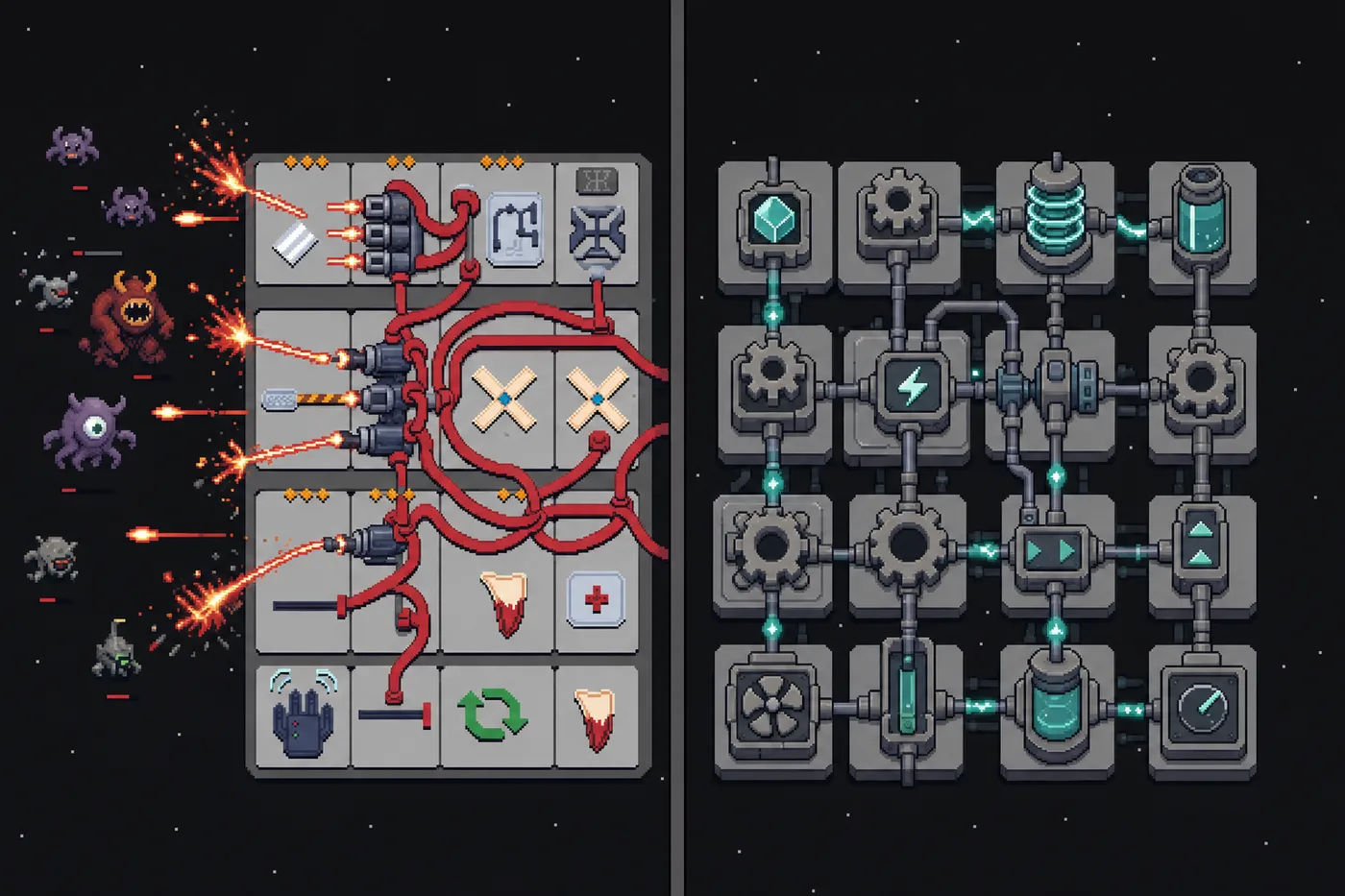
Both games ask you to snap modules onto a board to automate resource generation and combat, but they land in different genres once you actually play them. Wireworks is a real-time roguelike auto-battler/tower-defense where enemies rush your base every wave and you wire logic blocks together on the fly; Rogue Voltage is a more deliberate, RPG-style battler where modules manage resource gain and spending rather than driving live combat. As of August 2026, here's the honest side-by-side:
| Wireworks | Rogue Voltage | |
|---|---|---|
| Steam app ID | 4206270 | 1494560 |
| Price (as of Aug 2026) | $6.99 | $15.99 |
| Reviews | 570 reviews, 90% positive ("Very Positive") | 644 reviews, 92% positive ("Very Positive") |
| Genre | Real-time roguelike tower-defense / auto-battler | Module-based RPG battler with resource management |
| Pace | Fast — waves rush your base, live wiring under pressure | Slower, more turn-based/deliberate |
| Run length | A full standard run is ~30 waves; Endless mode extends indefinitely (players report reaching wave 300-600+) | Not covered in our source material — check the Rogue Voltage store page |
| Developer | Solo dev JJJ (JJJ Games), previously made Dungeons & Jewels | Different studio |
| Concurrent players (Aug 2026 snapshot) | 51 | Not tracked in our sources |
Both sit in the same "Very Positive" review tier and both are built around wiring/module systems, which is exactly why they get compared so often — but Wireworks is the cheaper, faster, more chaotic pick, and Rogue Voltage is the pricier, calmer one.
The dev's own take
This comparison isn't speculation — Wireworks' solo developer JJJ recommended Rogue Voltage himself. Asked on Discord in April 2026 whether there were similar games to Wireworks for someone who also liked Noita's "logical deck-improv" style, JJJ replied: "You might like 'Rogue Voltage', it has a module-based system that manages resource gain/spending for a more simple RPG battle style." (dev JJJ, JJJ Games Discord, April 5 2026). That's a direct acknowledgment that the two games share DNA but serve different tastes — Rogue Voltage for a "more simple RPG battle style," Wireworks for the faster real-time wave-defense loop.
Which is more complex?
Wireworks' complexity comes from real-time pressure: you're wiring modules, managing adjacency rules, and reacting to enemy waves simultaneously, with systems like wand cast caps (once every 5 frames), 99 MP caps, and horizontal-only adjacency to learn. Rogue Voltage's complexity is more about resource-management planning without the live-combat time pressure, per JJJ's own description of it as a "more simple RPG battle style." If you want mechanical depth under a ticking clock, Wireworks is the harder game moment-to-moment. If you want to think through a build without waves actively rushing you, Rogue Voltage is the gentler pick — though for a definitive breakdown of its systems, the Rogue Voltage store page and its own community are the authority; our source material only covers Wireworks in depth.
Which is cheaper, and is it worth it?
At $6.99, Wireworks costs less than half of Rogue Voltage's $15.99, while carrying a comparable review score (90% vs 92% Very Positive as of August 2026). Wireworks also ships with English, Simplified Chinese, Korean, and Brazilian Portuguese language support (added in the July 27 2026 Localization Update), a demo you can try before buying, and Endless mode as a genuinely open-ended value-add — the developer has stated Endless gets more playtime from most of the community than the base 30-wave campaign. Whether Rogue Voltage's higher price is justified comes down to whether you prefer its slower RPG-battle pacing over Wireworks' real-time wave-defense chaos.
games like rogue voltage
If you like Rogue Voltage's module-based resource management, Wireworks is the closest recommendation available — and it comes from Rogue Voltage's own genre-neighbor's developer, since JJJ pointed players in that direction himself. Beyond Wireworks, players hunting for "games like Rogue Voltage" are typically looking for one of two things: more wiring/module-based systems, or more roguelike item-synergy builds. A few starting points, based on what our sources cover:
- Wireworks ($6.99, 90% Very Positive) — trades Rogue Voltage's turn-based RPG battling for real-time base defense, but keeps the "wire modules together to automate a system" core. Best if you want more speed and pressure.
- Dungeons & Jewels — JJJ's earlier game, made before Wireworks. The developer has described it as older and "a bit janky" by comparison (his own words, on why he wouldn't bundle it with Wireworks), but it's worth a look for fans of his design sensibility.
- Luck be a Landlord (11,516 reviews, 93% Very Positive, $9.99) — a roguelike deckbuilder/slot-machine hybrid, not module-wiring, but scratches a similar "watch your build synergize and snowball" itch.
- Backpack Battles (20,569 reviews, 91% Very Positive, $14.99) — item-synergy auto-battler with inventory-Tetris placement rather than wiring, but shares the "arrange pieces so they combo automatically" appeal.
None of these are one-to-one substitutes for Rogue Voltage's specific module/resource system — if that exact mechanic is what you're after, Wireworks is the nearest available comparison, confirmed directly by cross-recommendation between the two communities.
Bottom line
Pick Wireworks if: you want a cheap ($6.99), fast, real-time roguelike tower-defense with an active Endless-mode scene and a solo developer who patches frequently and answers players directly on Discord.
Pick Rogue Voltage if: you want the calmer, more deliberate RPG-battle pacing that Wireworks' own developer described when he recommended it — module-based resource management without the live-wave pressure.
Either way, both games currently sit at "Very Positive" on Steam (90%+ positive review rate as of August 2026), so you're unlikely to regret either purchase — the real decision is pace, not quality.
Unofficial, community-compiled. Balance numbers drift between patches — trust in-game tooltips. Sources: developer answers on the JJJ Games Discord, Steam patch notes.